
CNC Sinker EDM
CNC Die Sinking EDM
Mirror Finish, Fully Programmable
Full 3-axis CNC. Orbital machining. Finish down to Ra 0.1 μm. Ten models up to 1800×800 mm.
Sammlite CNC die sinking EDM machines control X, Y and Z under CNC, so cavities are roughed, orbited and finished to a mirror surface automatically, and several electrodes or cavities run in one program. From compact precision sinkers to heavy column-type machines for automotive molds.
Why Buyers Choose Sammlite
- Direct manufacturer, 20+ years
- Exported to 30+ countries
- Siemens, Panasonic, THK, PMI parts
- ISO 9001 · CE design
- 1-year warranty, lifetime support
What Makes a Die Sinking EDM “CNC”?
On a basic ZNC sinker only the Z axis (depth) is numerically controlled; the operator positions X and Y by handwheel. A CNC die sinking EDM controls all three axes simultaneously. That unlocks orbital (planetary) machining, where the electrode moves in a small controlled path while sinking, so one electrode can rough and finish the side walls, compensate for spark gap and produce sharp, uniform cavities. It also enables multi-cavity programs, automatic positioning between electrodes, vector and spherical machining, and adaptive generator control that keeps sparking stable without operator intervention.
The result is a better surface finish (down to Ra 0.1 μm on our CNC300–CNC450), lower electrode wear (below 0.05%), fewer electrodes per cavity and far less operator time, which is why precision mold makers choose CNC sinkers for production work.
CNC Sinker Range
Choose Your CNC Die Sinking EDM
Bed-type precision sinkers and column (ram) type sinkers for large molds.
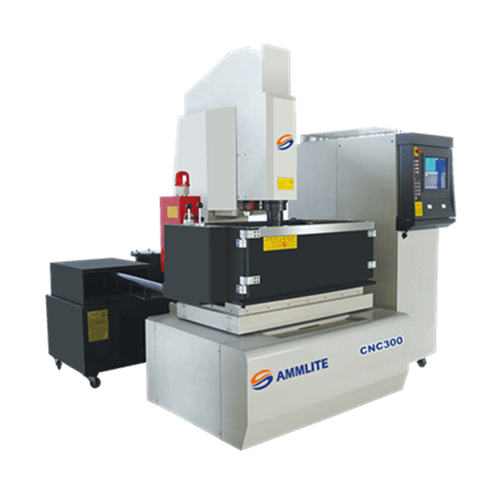
Precision · Bed Type
CNC300 / CNC350
Best for: Precision inserts and small mirror-finish cavities.
- X/Y travel300×200 / 350×250 mm
- Z travel250 mm
- Max electrode25 / 50 kg
- Best roughnessRa < 0.1 μm
- Electrode wear< 0.05%
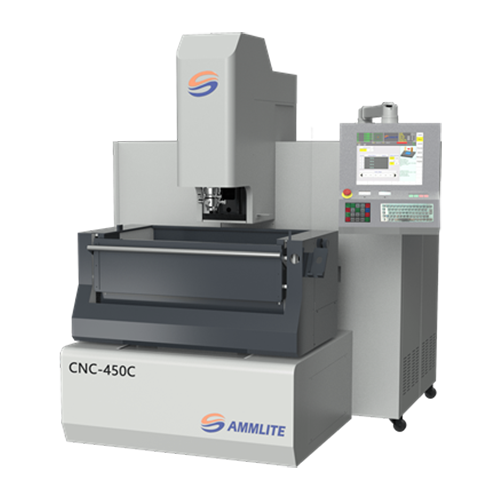
Precision · Bed Type
CNC400 / CNC450
Best for: Mid-size precision molds.
- X/Y travel400×300 / 450×350 mm
- Z travel300 mm
- Max electrode50 kg
- Best roughnessRa < 0.1 μm
- Position accuracy0.008 mm
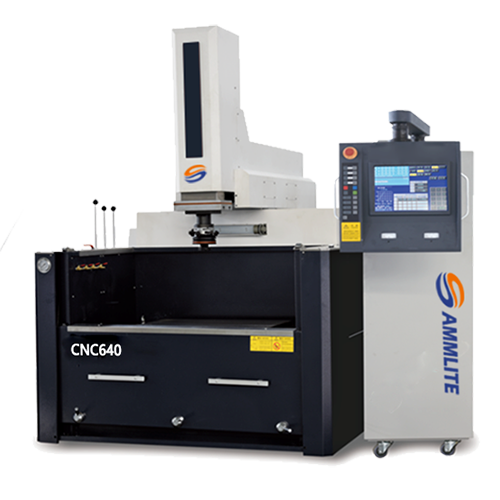
Column (Ram) Type
CNC540 / CNC640
Best for: Medium-large molds with heavy electrodes.
- X/Y travel500×400 / 600×400 mm
- Z travel300 / 350 mm
- Max electrode100 / 150 kg
- Best roughnessRa < 0.2 μm
- Electrode wear< 0.1%
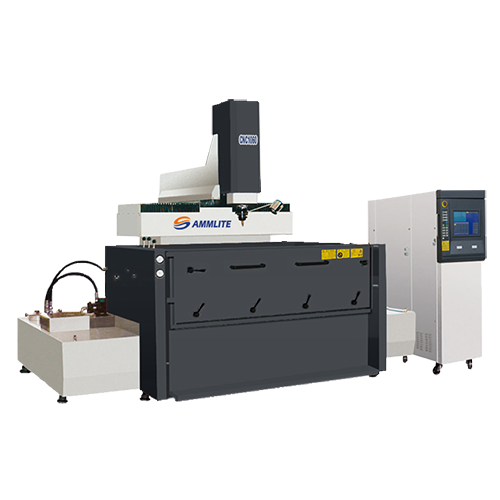
Column (Ram) Type
CNC850 / CNC1060
Best for: Automotive and appliance molds.
- X/Y travel850×500 / 1000×600 mm
- Z travel400 mm
- Max electrode180 / 200 kg
- Best roughnessRa < 0.2 μm
- Position accuracy0.015 mm
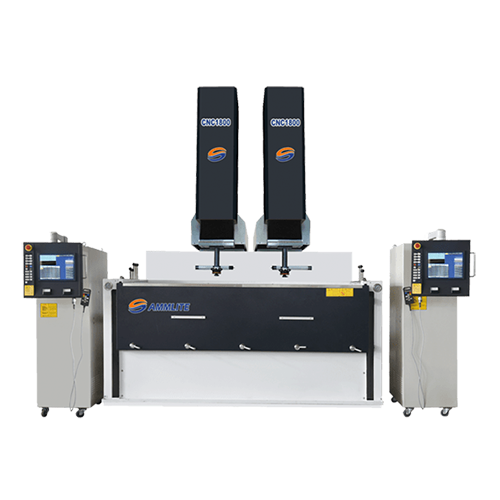
Column (Ram) Type
CNC1570 / CNC1800
Best for: Oversized bumper and dashboard molds.
- X/Y travel1500×700 / 1800×800 mm
- Z travel500 mm
- Max electrode200 / 250 kg
- Best roughnessRa < 0.2 μm
- Weight11.5 / 15 t
Only Need Simple Sinking?
For single cavities and repair work, our ZNC machines cost less.
Advantages
What You Gain with CNC Control
Orbital Machining
Electrode orbits while sinking, finishing side walls and compensating spark gap with one electrode.
Mirror Finish
Fine finishing circuits reach Ra < 0.1 μm on precision models, reducing or eliminating polishing.
Multi-Cavity Programs
Machine several cavities or swap electrodes in one program, then let the machine run.
Lower Electrode Wear
Wear below 0.05% means fewer electrodes and more accurate cavity depth.
Adaptive Control
The generator adjusts to flushing and gap conditions to prevent arcing automatically.
Repeatable Accuracy
0.008 mm positioning on precision models; programs repeat exactly for every mold.
Process
How a Cavity Is Made on a CNC Sinker
From electrode to mirror finish in four stages.
1. Electrode
Copper or graphite electrode is machined undersize by the spark gap and orbit allowance.
2. Set-Up
Electrode and workpiece are located automatically by touch-off; the CNC program defines depth, orbit and power stages.
3. Roughing
High-current sparking removes material fast with flushing through or around the electrode.
4. Finishing
Lower energy and orbital passes refine the side walls and floor to the specified Ra.
Side-by-Side
CNC Die Sinking EDM Specifications
| Model | X/Y Travel (mm) | Z Travel (mm) | Max Electrode | Table to Electrode | Best Roughness | Electrode Wear | Accuracy |
|---|---|---|---|---|---|---|---|
| CNC300 | 300×200 | 250 | 25 kg | 540 mm | Ra < 0.1 μm | < 0.05% | 0.008 mm |
| CNC350 | 350×250 | 250 | 50 kg | 540 mm | Ra < 0.1 μm | < 0.05% | 0.008 mm |
| CNC400 | 400×300 | 300 | 50 kg | 580 mm | Ra < 0.1 μm | < 0.05% | 0.008 mm |
| CNC450 | 450×350 | 300 | 50 kg | 580 mm | Ra < 0.1 μm | < 0.05% | 0.008 mm |
| CNC540 | 500×400 | 300 | 100 kg | 600 mm | Ra < 0.2 μm | < 0.1% | 0.015 mm |
| CNC640 | 600×400 | 350 | 150 kg | 700 mm | Ra < 0.2 μm | < 0.1% | 0.015 mm |
| CNC850 | 850×500 | 400 | 180 kg | 800 mm | Ra < 0.2 μm | < 0.1% | 0.015 mm |
| CNC1060 | 1000×600 | 400 | 200 kg | 950 mm | Ra < 0.2 μm | < 0.1% | 0.015 mm |
| CNC1570 | 1500×700 | 500 | 200 kg | 800 mm | Ra < 0.2 μm | < 0.1% | 0.015 mm |
| CNC1800 | 1800×800 | 500 | 250 kg | 950 mm | Ra < 0.2 μm | < 0.1% | 0.015 mm |
Free Quotation
Get Your CNC Sinker EDM Quote
Send us your mold size, electrode size and finish requirement. We reply within 24 hours with a model recommendation and price.
- Tell us about your partsMaterial, thickness, size, accuracy and taper requirements.
- Get a recommendationOur engineers suggest the right model and configuration within 24 hours.
- Receive your quotationPrice, lead time, shipping and installation plan.